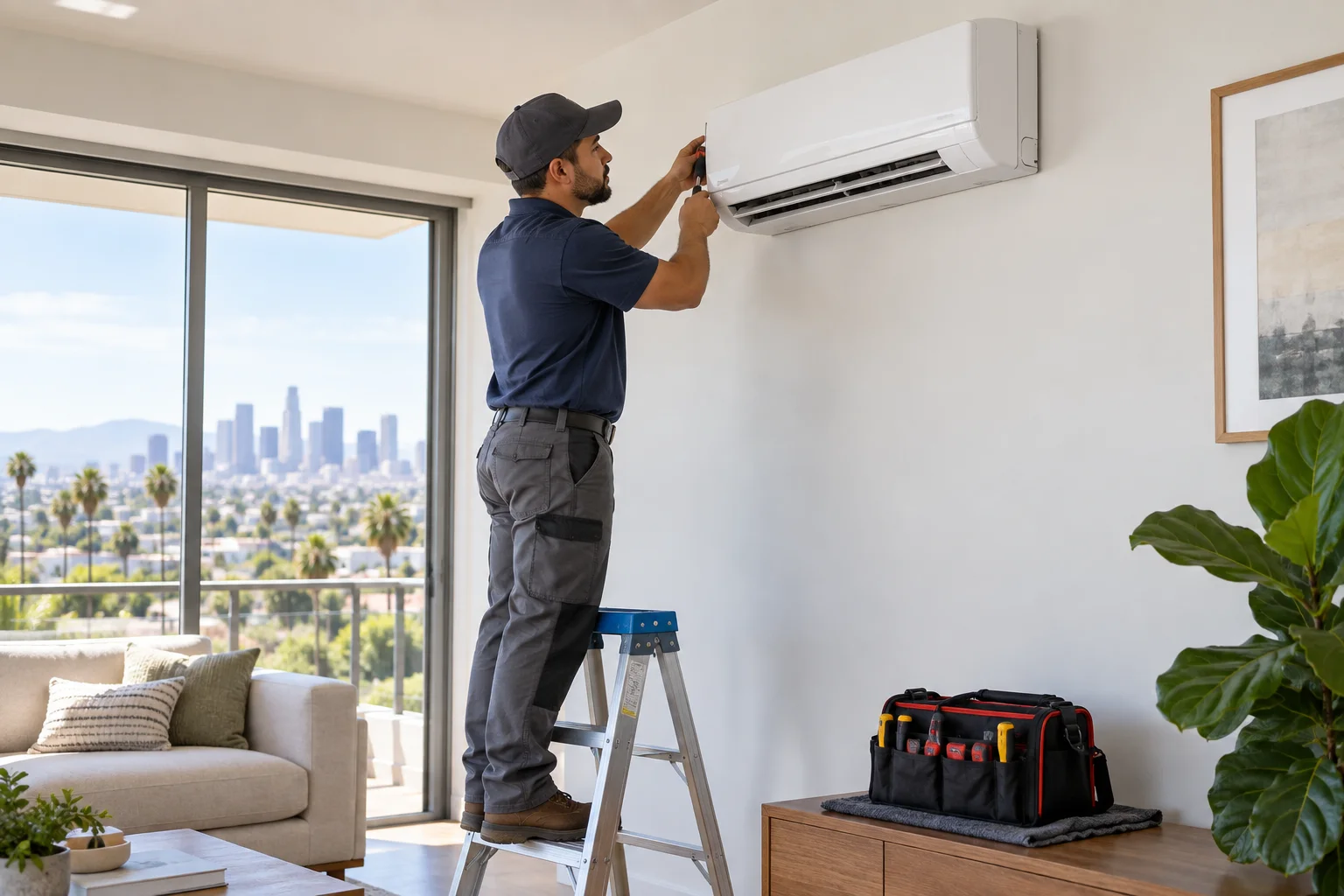
A complete AC installation estimate describes a working, permitted system, not just a box of equipment. It should show how the system was sized, what equipment and refrigerant it uses, what happens to your ducts and wiring, how permits and California Energy Code testing are handled, and how the system is started up and handed over. Use this checklist to compare quotes line by line before you sign.
Sizing: ask for a load calculation
The right size for a new system depends on your house, not the old unit's label. A load calculation, commonly done with the ACCA Manual J method, accounts for square footage, insulation, windows, sun exposure, air leakage and local climate. A Westwood home with west-facing glass and a valley home a few miles inland can have very different cooling loads even at the same size.
An oversized system cools quickly but runs in short cycles, which can leave rooms uneven and humidity higher. An undersized system runs constantly on hot days and may not keep up. Ask each contractor whether they performed a load calculation for your home and whether they will share the result. If a quote simply matches the tonnage of your old unit, ask why.
Equipment and refrigerant
The estimate should name the specific equipment, not just a brand or a tonnage. Look for model numbers for the outdoor unit, the indoor coil and the furnace or air handler, and check that they are listed as a matched system. Also note the efficiency ratings. Since 2023, new central air conditioners and heat pumps are rated using SEER2 and EER2, and California falls in the federal Southwest region, which has its own minimum efficiency standards.
Refrigerant matters too. Under federal rules, new residential split systems manufactured since January 1, 2025 use lower-impact refrigerants, most commonly the A2L refrigerants R-454B and R-32. A 2026 EPA rule change allows installation of R-410A equipment that was manufactured before 2025 while that inventory lasts. Either can be legitimate, but the estimate should say clearly which refrigerant your system uses so you can weigh future service and parts availability.
Your AC installation estimate checklist
Put each quote next to this list. Anything missing is either excluded or unclear, and both are worth asking about.
- Load calculation performed for your home, with the result available to you
- Outdoor unit, indoor coil and furnace or air handler model numbers and efficiency ratings
- Refrigerant type for the new system
- Thermostat model and whether it is compatible with the new equipment
- Removal and disposal of old equipment, including proper refrigerant recovery
- Refrigerant line set: reused and flushed, or replaced, and why
- Electrical work: disconnect, breaker size and wiring changes, if needed
- Duct work: sealing, repairs, modifications or replacement, with a clear description
- Condensate drain, secondary drain pan and float switch where the unit is in an attic
- Equipment pad or stand, and any crane or lift for rooftop or difficult sites
- Building permit and inspection, and who obtains them
- Energy Code testing and third-party verification, and who schedules it
- Startup, testing, homeowner walkthrough and warranty registration
- Payment schedule and what is excluded, such as drywall, painting or roof repair
Permits and Title 24 verification in Los Angeles
Replacing central air conditioning equipment in California generally requires a building permit. In the City of Los Angeles that is issued by the Department of Building and Safety (LADBS), while many other cities in LA County, such as Santa Monica, Beverly Hills and Culver City, have their own building departments. The contractor usually pulls the permit and schedules the inspection.
California's Energy Code, part of Title 24, adds verification steps for many system change-outs. Depending on the system, these can include duct sealing with a duct leakage test, refrigerant charge verification and airflow checks. A certified third-party rater confirms the results and registers them. That rater was known as a HERS rater; under the 2025 Energy Code, the program is called Energy Code Compliance (ECC). There are exceptions, for example for some short duct systems or ducts with asbestos-containing materials, so ask how the rules apply to your home.
A quote that leaves out the permit, or suggests skipping it to save money, is a red flag. Unpermitted work can complicate insurance claims, a home sale and future service.
Ducts, electrical and other work that changes the price
Much of the difference between quotes comes from what happens beyond the equipment. If your ducts are old, leaky or poorly sized, a new system will not perform to its rating. Required duct leakage testing may also reveal sealing work that must be done to pass. Ask the contractor to inspect the ducts and put any needed repairs in the estimate, rather than leaving them as a surprise after testing.
Electrical changes are common when moving from an older system or adding a heat pump. The estimate should say whether the existing circuit, breaker and disconnect are adequate. Attic installations in many Los Angeles homes also need attention to access, the platform and the drain safeguards that protect ceilings from condensate leaks.
Red flags when comparing installation quotes
Most contractors quote honestly, but a few patterns deserve a closer look. Be cautious with a quote that:
- Gives a price over the phone without anyone looking at the house, ducts or electrical panel
- Sizes the system only by square footage or by the old unit's tonnage
- Leaves out the permit or suggests skipping it
- Does not mention Energy Code testing or who pays if ducts fail the leakage test
- Lists equipment by brand only, without model numbers or refrigerant type
- Pressures you to sign the same day with an expiring discount
Contract, payment and license basics
Before signing, check the contractor's license on the Contractors State License Board website and confirm it is active and carries the right classification for HVAC work, which is C-20. California home improvement contracts must be in writing, and state law limits the down payment on most home improvement contracts to $1,000 or 10 percent of the contract price, whichever is less. Payments after that should follow the progress of the work. Read the warranty terms for equipment and for labor separately, and note who handles warranty registration.
Startup, handover and documents
Also ask how the old equipment will be handled. Refrigerant must be recovered by certified technicians before the old unit is hauled away, and the estimate should say that disposal is included. If the new outdoor unit sits in a different spot, or the indoor unit changes size, confirm who patches any openings, relocates the pad and restores landscaping or finishes.
The final stage of an installation is easy to rush. The estimate should include a proper startup: evacuating the lines, confirming the refrigerant charge, checking airflow and temperatures, and testing the thermostat and safety controls. At handover, you should receive:
- Model and serial numbers for each piece of equipment
- Warranty information and confirmation of registration, where required
- The permit, inspection sign-off and verification records
- Thermostat instructions and filter size and location
- Recommended maintenance and who to call for service
What we need from you to quote it
To prepare an installation estimate, we need the home's address and approximate square footage, the rooms that have comfort problems, photos of the current indoor and outdoor equipment labels, where the equipment and ducts are located, and the electrical panel's location. Tell us whether you are considering a heat pump or ductless system. Call Chain Construction at (213) 519-8066. Installation work is performed by our licensed HVAC partner.