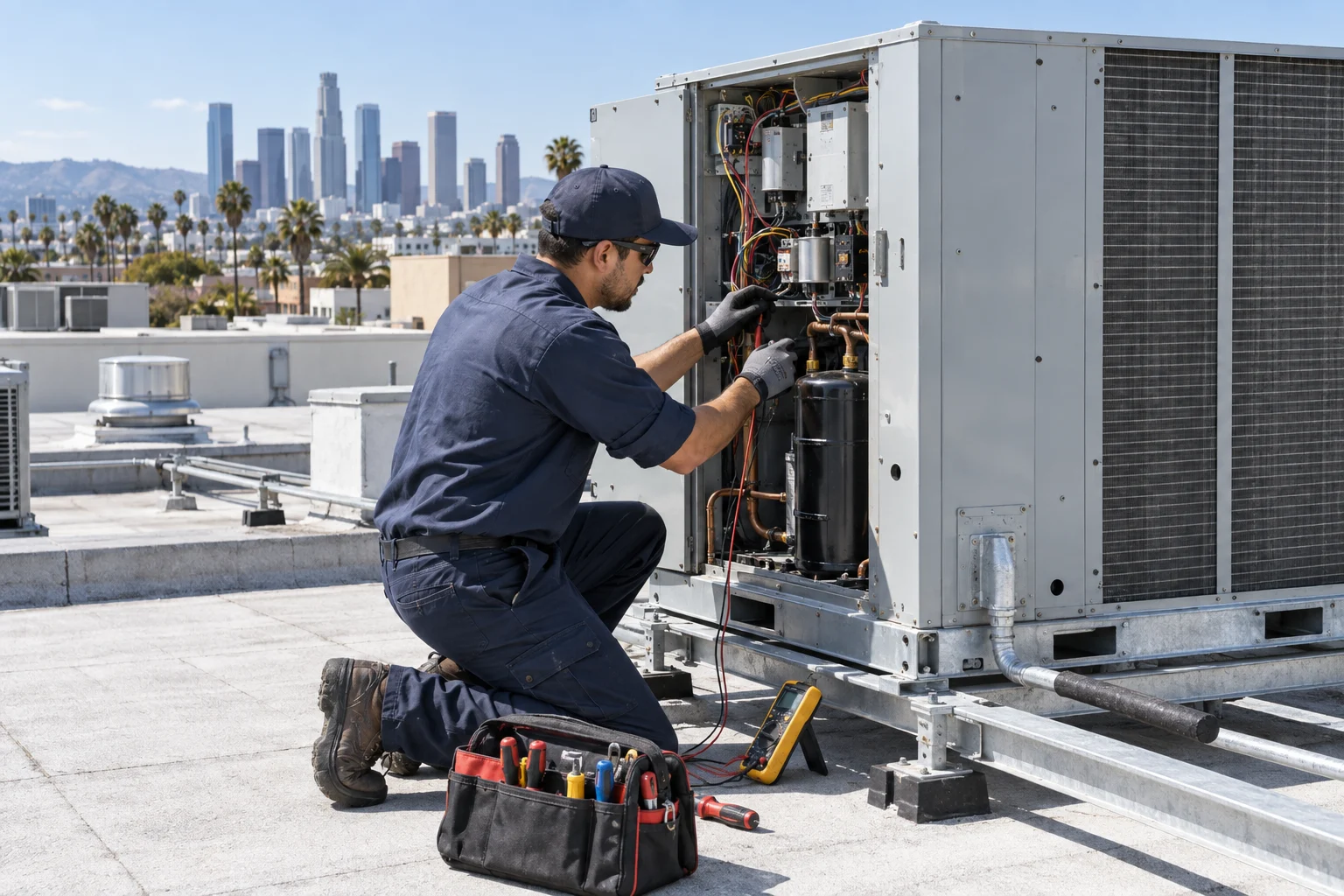
Commercial rooftop AC repair depends as much on access and approvals as it does on the equipment. Before a technician can diagnose a rooftop package unit, someone has to get them safely onto the roof, tell them which unit serves the problem area, and be ready to approve the repair. Sorting this out before the visit is the fastest way to restore cooling to your store, office or restaurant.
Identify the unit and the space it serves
Many commercial buildings have several rooftop units, and it is not always obvious which one serves which space. Before the visit, gather what you know about the equipment and the complaint.
- The rooms, suite or tenant space that is not cooling, and since when
- The number of rooftop units and any labels or numbers painted on them
- Thermostat or building management system readings and alarms
- Recent service, filter changes or roof work by others
- Equipment records, drawings or a maintenance log if the building has them
If nobody knows which unit serves the area, tell us. The technician can trace it, but it takes longer, and that time is worth planning for.
Plan the roof access route
Rooftop access is the most common cause of delays. The technician needs a safe, authorized route to the roof and to the unit itself. Describe it in advance:
- Whether access is by interior roof hatch, stairway to a roof door or exterior ladder
- Who holds the keys, and whether an escort from the building is required
- Hatch size, ladder condition and whether a hatch is secured by a lock or alarm
- Guardrails, skylights and roof edges near the unit
- Whether the roof surface has walkway pads or areas that should not be walked on
- Where the technician can park and bring tools and parts through the building
If the only access is an exterior extension ladder, mention the roof height. The technician decides what equipment and safety measures the work requires; your job is to describe what is there and who can open it.
What happens during commercial rooftop AC repair
Once on the roof, the technician confirms which unit serves the problem area, checks its controls and power, and tests the cooling circuit. A rooftop package unit holds the compressor, coils, blower and controls in one cabinet, and many also include a gas heat section. Common findings include failed electrical components, dirty or blocked coils, clogged filters, worn belts on older blowers, economizer problems and refrigerant leaks.
The technician may also need access inside the building, for example to the thermostat, a control panel or the ceiling area near the supply and return ducts. Plan for that as well as roof access. After the repair, the technician should test the unit, confirm the space is cooling and leave a written report of the work done and any other concerns noticed on the roof.
Coordinate with building management and tenants
In multi-tenant buildings, the property manager or building engineer often controls roof access, and some require vendor registration or proof of insurance before a contractor can enter. Confirm those requirements early so the visit is not turned away at the door.
Let affected tenants or staff know the system will be off during the repair. If the unit sits above a dining room, a retail floor or an office that cannot be disrupted, plan the timing around that. Work on the roof can be noisy, and some repairs require briefly shutting off power to the unit.
Schedule after-hours or off-peak visits
For restaurants, retail and offices, the best time for rooftop work is often before opening, after closing or on a weekend. After-hours visits usually cost more and need someone on site to provide access. They also avoid moving parts and tools through a crowded space during business hours.
If the visit happens after hours, make sure the person who opens the building knows where the roof access is and can stay until the technician leaves. Alarm codes, elevator keys and lighting in stairwells or mechanical rooms are easy to overlook and can stall a visit that has already been scheduled.
Southern California heat waves drive a surge in commercial service calls. If your building depends on one or two rooftop units, plan preventive maintenance in spring rather than waiting for the first hot week.
Decide in advance who approves the repair
The technician will find the fault and write an estimate. If the person on site cannot approve it, the repair waits. Before the visit, decide:
- Who receives the diagnosis and the written estimate
- Who can approve a repair and up to what amount
- Whether the tenant or the landlord is responsible for this unit under the lease
- How the invoice and service report should be addressed
A diagnosis does not authorize replacement. If replacing the rooftop unit is proposed, treat it as a separate project. It typically involves a crane or lift, a curb adapter if the new unit does not match the old curb, permits and coordination with the roof and electrical trades. Our licensed HVAC partner can price that separately so you can compare it with the repair.
What we need from you to schedule it
Send us the building address, the affected space, the number of rooftop units, the roof access method and contact, building vendor requirements and your preferred time window. Photos of the unit labels help if someone can safely take them. Call Chain Construction at (213) 519-8066 to set up a diagnostic visit with our licensed HVAC partner in Los Angeles County.