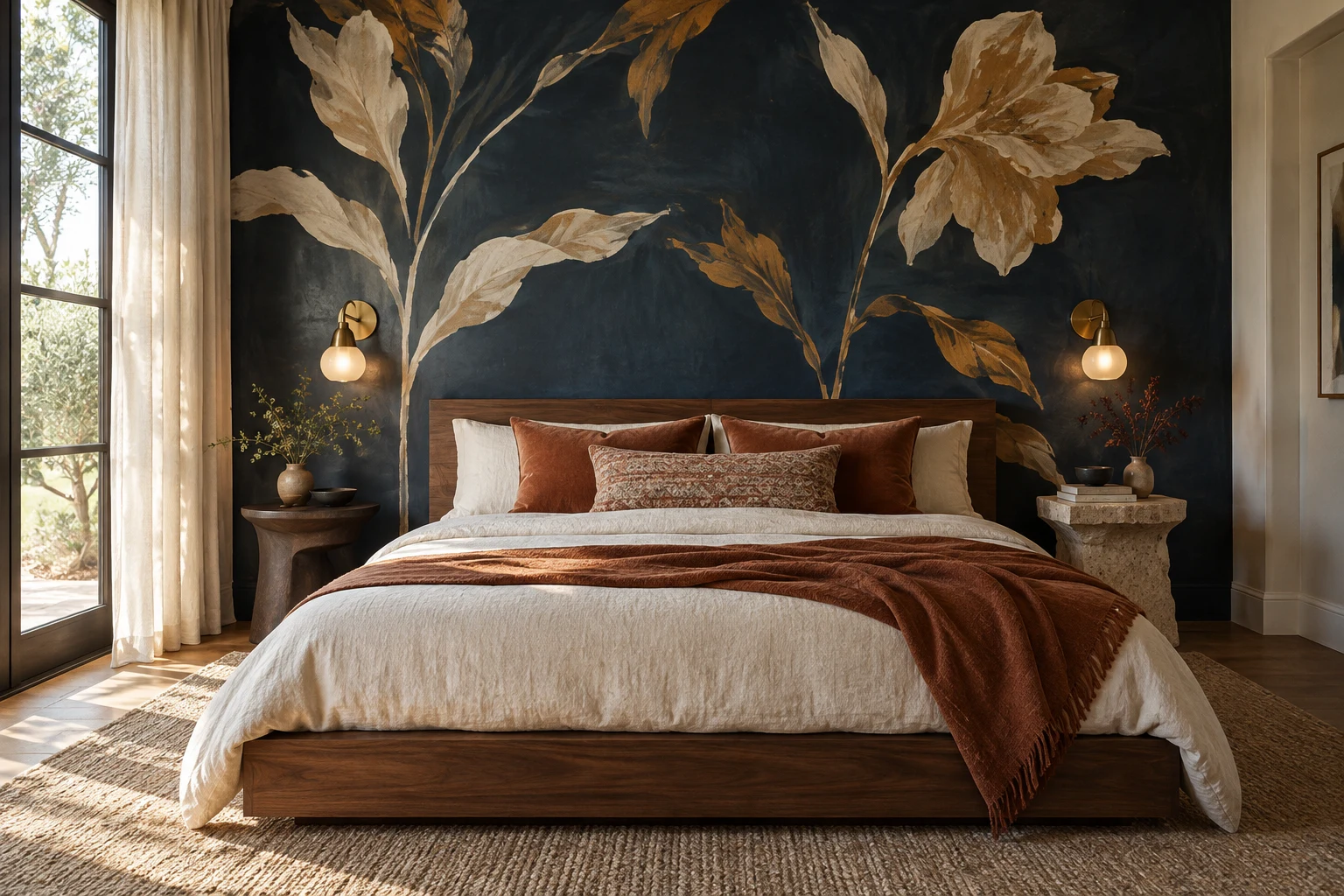
The best accent wall ideas start with the room, not the material: which wall people actually look at, how the light moves across it, and what the space needs, whether that's warmth, drama, texture or calm. Below you'll find the main options for Los Angeles homes, from wood slats and limewash to wallpaper, color, texture, microcement and lighting, with what each does well and what to plan before you commit.
Accent wall ideas start with choosing the right wall
An accent wall should be the wall your eye goes to anyway. Stand at the main entrance to the room and at the spot where you spend the most time, such as the sofa, the bed or the dining table. The wall you face from both places is usually the candidate: behind a headboard, behind a sofa, the far wall of a dining room, or the wall behind a desk that shows up on video calls.
Then count the interruptions. Windows, doors, vents, thermostats, outlets and switches all break up a surface. A wall with several openings suits a simple treatment like color or limewash; a clean, uninterrupted wall can carry a pattern, wood slats or a large-scale wallpaper. Take one wide photo of the whole room and one straight-on photo of the wall. The first shows how the wall relates to the furniture; the second shows proportions and obstacles.
Light direction matters in Southern California too. A west-facing wall can glow orange in late afternoon and look flat in the morning, while a north-facing room gets steady, cooler light all day. In open-plan homes, pick a wall that anchors a zone, such as the dining area or the TV corner, so the accent reads as deliberate rather than random.
- Small or dark room: lighter color, limewash or a soft wash of light
- Tall living room: vertical wood slats or a large-scale wallpaper
- Bedroom: limewash, textured plaster or wallpaper behind the headboard
- Home office: wood slats or a deep color for a warm video-call backdrop
- Minimal, modern space: microcement or a single bold color
- Busy entry or hallway: a durable, wipeable finish
Wood slats for warmth, rhythm and a modern look
Wood slat walls are one of the most popular accent wall ideas in LA's modern and mid-century homes. Vertical slats draw the eye upward and make ceilings feel taller; horizontal slats widen a room and suit long, low spaces. Tone matters: pale oak reads calm and Scandinavian, walnut and smoked finishes feel richer and moodier. Compare samples against your floor and cabinetry, not in isolation.
Slats can run full height, stop at a defined panel behind a bed or TV, or wrap onto the ceiling. The planning happens at the edges and around outlets, and you'll need to decide between solid slats and felt-backed acoustic panels. Our wood slat planning guide covers spacing, outlet boxes and edge details in depth.
Limewash for soft, cloud-like color
Limewash is a mineral paint made from lime, applied with a brush in overlapping strokes. It dries to a matte, softly mottled finish that looks different in morning and evening light, which is why it pairs so well with California sunlight and natural materials like linen, rattan and light wood. Earthy tones such as clay, sage, sand and warm gray are the classic choices.
Limewash bonds best to porous mineral surfaces like plaster, masonry and brick. On painted drywall, manufacturers usually specify a mineral primer first. It's less scrubbable than standard wall paint, so it suits bedrooms, living rooms and dining rooms better than a busy mudroom. If you're torn between limewash and a smoother stone look, see our comparison of limewash and microcement.
Microcement and textured plaster for a stone-like surface
Microcement is a thin, cement-based coating troweled on in several layers and sealed. It creates a continuous, seamless surface with the quiet depth of concrete or stone, and it works well in minimalist interiors, entryways and behind a fireplace or TV. Sheen ranges from matte to satin depending on the system and sealer.
Textured plasters, including Venetian-style finishes, sit in the same family: layered, hand-applied and full of subtle movement. Both need a sound, stable wall. Cracks, loose texture and old patches should be repaired first, since a thin decorative coat can show what's underneath. Ask to see a sample board of the actual system, including the sealer, because the protective coat changes both the look and the feel.
Wallpaper, murals and bold color
Wallpaper brings pattern that paint can't: botanicals, geometrics, grasscloth, textured weaves or full-wall murals. A single papered wall lets you try a bold print without committing a whole room. Scale is the key decision. A large repeat that looks dramatic on a sample can feel busy in a small bedroom, while a small print can disappear on a tall living room wall.
Order a generous sample and tape it to the wall for a few days. Measure height and width, note windows and doors, and ask how seams, pattern matching and the edges at corners and ceilings will be handled. Natural-fiber papers like grasscloth show seams by nature, so plan them where furniture or art will sit.
Paint is the fastest and most flexible option, and in a room full of strong furniture or art, one confident color can be enough. Deep colors like ink blue, forest green or terracotta make a wall recede and feel enveloping; lighter tints brighten a dark corner. Try at least two large samples on the actual wall and look at them morning, afternoon and after dark.
A few details raise a painted wall from basic to finished: crisp edges at the ceiling and adjoining walls, a decision about whether to paint the baseboard to match, and a wall prepared well enough that the color doesn't highlight old patches. Color blocking, arches and painted panels are easy variations if a full wall feels like too much. Paint also pairs well with other ideas, for example a deep color behind open wood shelving or a painted panel framed by picture lights.
Lighting that makes the accent wall work at night
An accent wall is only as good as the light on it. Light placed close to the wall and aimed along it, called grazing light, exaggerates texture in limewash, plaster, stone and slats. Light from farther back gives an even wash that suits wallpaper and color. Sconces add warmth and frame a bed or console; LED strips hidden in a channel or behind slats outline the wall with a soft glow.
Plan the lighting before the finish goes on, since hardwired fixtures, new switches and dimmers may need new wiring. That work is done by a licensed electrician, and in the City of Los Angeles new wiring typically requires an electrical permit. Our accent wall lighting guide explains placement, dimmers and when you need an electrician.
Whatever the finish, keep the light warm and dimmable. A wall that looks bright and crisp at noon often feels best at night under a low, warm glow, and a dimmer lets one wall serve both moods.
What to send for an accent wall quote
- A wide photo of the room and a straight-on photo of the wall
- Approximate wall width and height, with doors, windows and outlets marked
- The current wall finish and any cracks, texture or damage
- Two or three inspiration images, with a note on what you like in each
- Whether you want lighting added or changed
- Your city or ZIP code and preferred timing
You don't need to choose a material before you reach out. Tell us the mood you want and how the room is used, and we can compare options and bring samples. Final preparation, materials and scope depend on the actual wall.