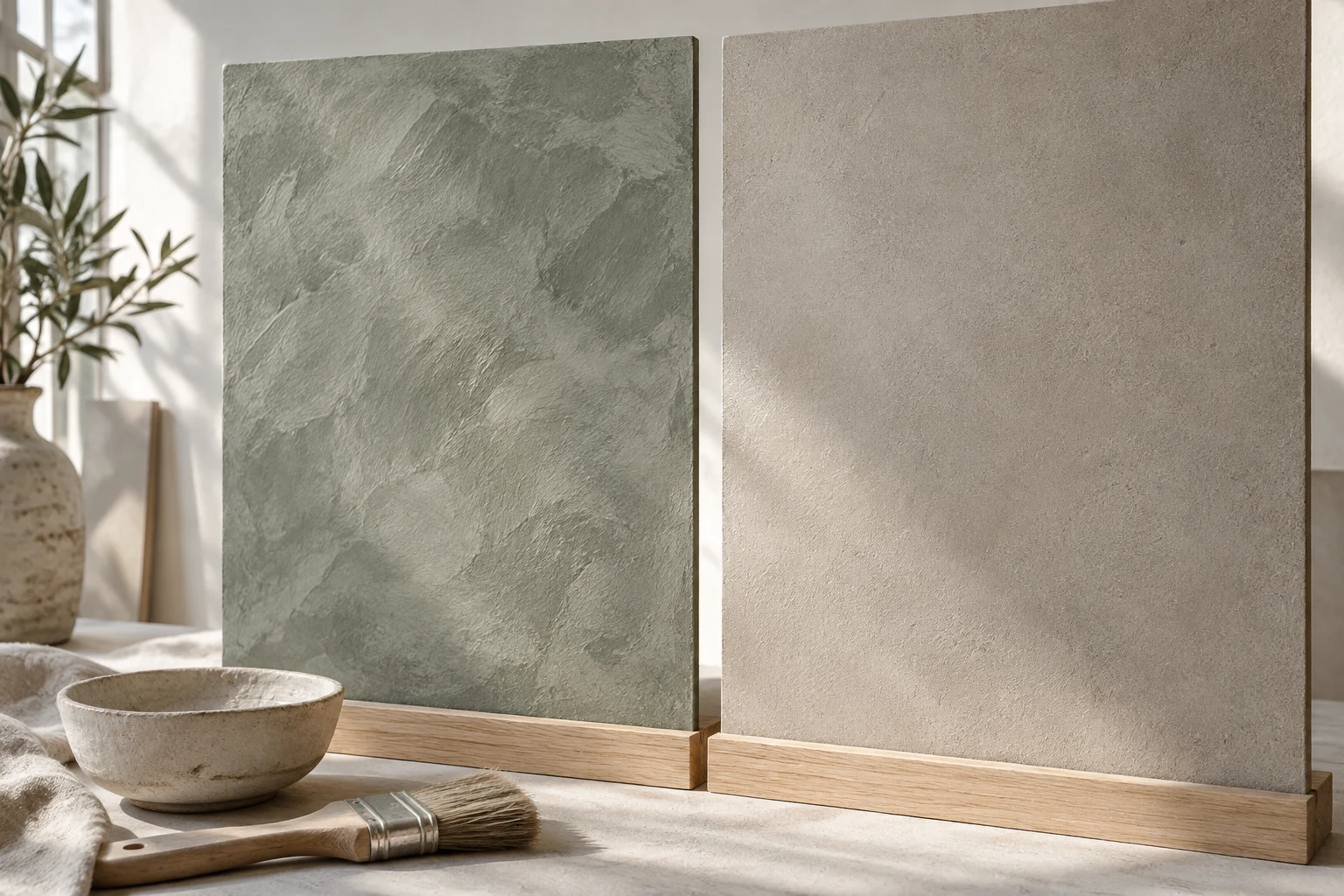
Choosing limewash vs microcement comes down to the look you want and how the wall will be used. Limewash gives soft, matte, brushed color that shifts with the light; microcement gives a continuous, stone-like surface that can be sealed for easier cleaning. This comparison walks through appearance, preparation, durability and repairs so you can pick the right finish for your accent wall.
The quick answer
- Choose limewash for a soft, matte, cloud-like wall in a bedroom, living room or dining room
- Choose microcement for a smooth, seamless, concrete- or stone-like surface
- Choose limewash if you want easy, blendable touch-ups and a lighter process
- Choose microcement if the wall needs to be wiped often or sits in a busier space
- Choose either only after seeing a real sample on your wall in your light
How limewash vs microcement looks in a room
Limewash is a lime-based mineral paint applied with a wide brush in crisscross strokes. As it cures, it develops a soft, mottled surface with visible movement and a chalky, velvety matte finish. It reads as color first and texture second. Warm earth tones, such as clay, sand, sage and soft gray, suit the relaxed, natural interiors common in Los Angeles.
Microcement is a cement-based coating with polymers, troweled on in thin layers and then sealed. The result is a continuous surface without grout lines, with subtle trowel marks and the quiet depth of polished concrete or honed stone. It reads as material first and color second. Depending on the system and sealer, the finish can be matte, satin or more polished.
In practice, limewash softens a room and microcement grounds it. A limewashed wall makes a bedroom feel calm and enveloping. A microcement wall behind a TV or fireplace makes a living room feel architectural and minimal.
Wall preparation and application
Limewash works best on porous mineral surfaces like plaster, brick and masonry, where it can soak in and bond. Most manufacturers specify a mineral or bonding primer over painted drywall. Application is relatively quick: usually two or more coats, with the look depending heavily on the brush technique. It's forgiving of minor wall texture, which can even add character.
Microcement needs more preparation and more skill. The wall has to be sound and stable, with cracks repaired and loose material removed. The system typically involves a primer, sometimes a reinforcing mesh, several base and finish coats with drying time in between, then a sealer. Because the layers are thin, movement or cracks in the wall behind can show through, so the substrate matters more than with limewash.
Durability, cleaning and touch-ups
Limewash is breathable and naturally matte, but it's not as scrubbable as standard interior paint. A light wipe is usually fine; hard scrubbing can lift or burnish the surface. The upside is repairs: a scuffed area can often be refreshed with another coat that blends into the existing movement.
Sealed microcement is more resistant to everyday marks and easier to wipe down, which is why it's popular for entries, hallways and commercial interiors. The trade-off is repair. A chip or crack is harder to hide invisibly, and matching a small patch to an aged, sealed surface takes skill. Resealing may be recommended over time depending on the product and how the wall is used.
Neither finish is automatically suitable for showers, splash zones or exteriors. Some microcement systems are designed for wet areas, but that depends on the specific product and its full waterproofing build-up. Confirm the manufacturer's requirements before using either finish outside a dry interior wall.
Light, sheen and the rest of the room
Both finishes come alive under side light. A lamp or sconce close to the wall exaggerates limewash movement and microcement trowel marks, while an even wash from a distance flattens them. Microcement with a satin sealer can pick up reflections from windows, so check how it looks against your brightest light source.
Think about the room's other surfaces. A room with glossy floors, glass and metal often benefits from a matte limewash. A room with soft fabrics, wood and plaster may welcome the contrast of a smoother microcement. Test samples near the flooring, sofa and curtains, not just on a white board.
Cost and time drivers to ask about
We don't quote either finish without seeing the wall, but you can compare them on the factors that drive the price.
Microcement generally involves more layers, more drying time and more specialized application than limewash. For both, the main drivers are wall size and height, how much repair the surface needs, the primer or base system required, access and ladders, number of colors or samples, and protection of floors and furniture in an occupied room. For microcement, the condition of the wall and any tile or patches underneath often has the biggest effect on the scope.
What we need from you to quote it
- A wide photo of the room and a straight-on photo of the wall
- Approximate width and height, with openings, outlets and switches marked
- The current surface: painted drywall, plaster, brick or tile
- Close-ups of any cracks, patches or existing texture
- Two reference images and a note on the color, movement or sheen you like
- Your ZIP code, timing and whether lighting is part of the plan
You don't have to decide between limewash and microcement before contacting us. Send photos and the mood you're after, and we'll suggest samples for both and a scope based on your actual wall.