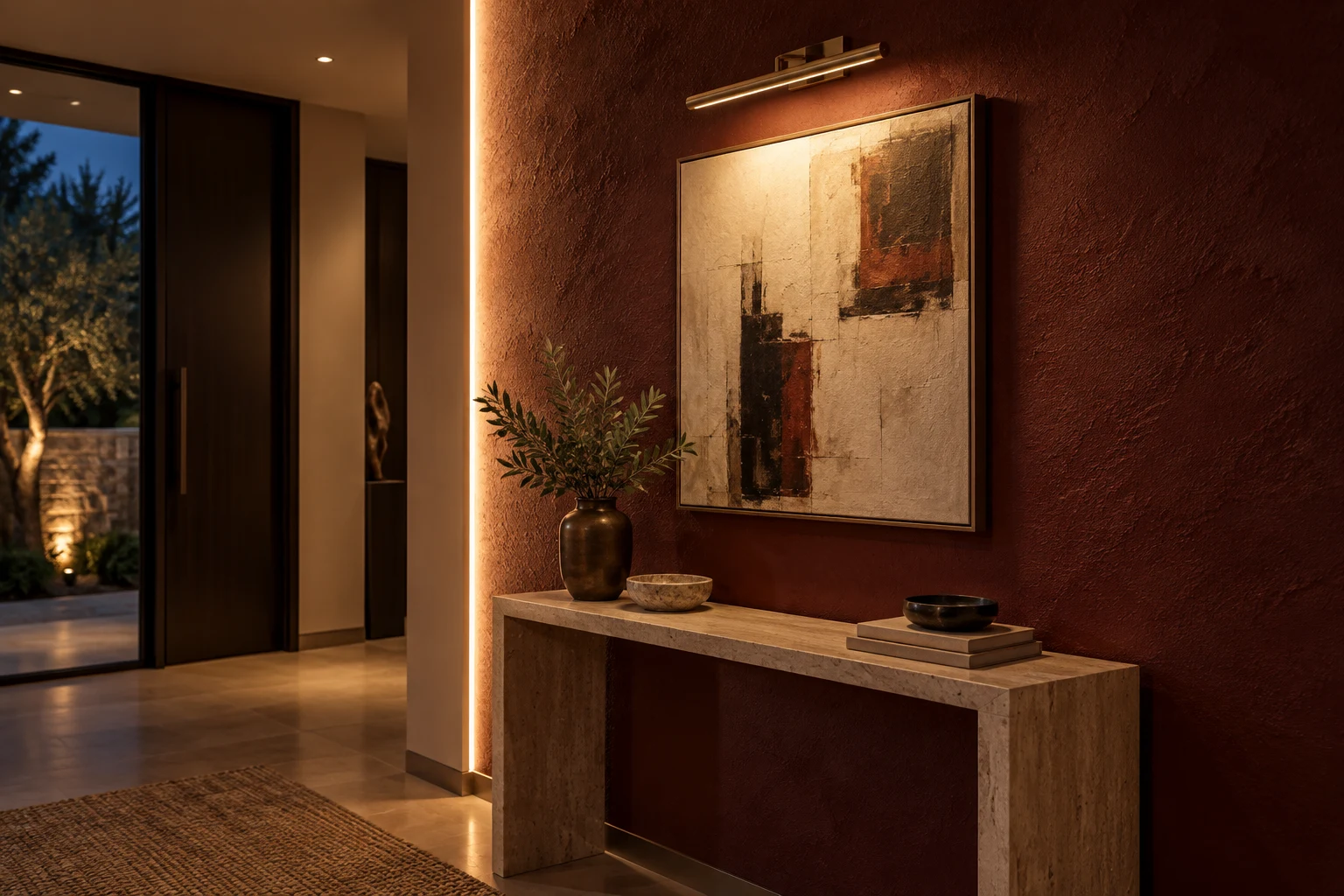
Good accent wall lighting decides whether your finish looks flat or dramatic after sunset. The right technique depends on the surface: grazing light for texture, an even wash for color and wallpaper, sconces for warmth and framing, and hidden LED channels for a soft outline. This guide explains where each goes, how to choose dimmers and color temperature, and when the work needs a licensed electrician.
Match the light to the finish
Light doesn't just brighten a wall; it reveals or hides its surface. Before choosing fixtures, decide what you want the light to do.
- Limewash, plaster, stone, brick and wood slats: grazing light to bring out texture
- Paint, wallpaper and murals: an even wash to show color and pattern
- Artwork or a styled console: focused accent light or a picture light
- Bedrooms and lounges: sconces or a low LED glow for warmth
- Smooth drywall or microcement: avoid harsh grazing that exaggerates flaws
Grazing vs washing: how placement changes the look
Grazing light sits very close to the wall and shines along its surface, from the ceiling down or the floor up. Every ridge, trowel mark and slat edge casts a shadow, so texture becomes dramatic. The catch is that grazing also highlights imperfections: patches, seams and uneven drywall show up clearly. Use it on walls where texture is the point.
Washing places the light farther from the wall, usually in the ceiling, and spreads it evenly across the surface. Texture softens, color reads more accurately and the wall looks uniform. Adjustable recessed fixtures or wall-wash trims are common tools for this.
Before committing, test it. In the evening, hold a flashlight or portable LED bar at the proposed distance and angle and look from your main seat. You'll see quickly whether the effect is flattering or too harsh.
LED channels, sconces and picture lights
LED strip lighting set into an aluminum channel with a diffuser gives a continuous line of light without visible dots. Channels can be recessed into the ceiling along the wall for a grazing effect, set into a soffit, run at the base of a floating shelf, or built into the gaps of a wood slat wall. Every LED strip needs a driver or power supply, and that driver has to stay accessible and ventilated, never sealed behind the finish.
Wall sconces add warmth and frame a bed, sofa or console. Hardwired sconces need a junction box in the right spot, so their height and spacing should be set before a wall is slatted, papered or plastered. Plug-in sconces avoid new wiring but leave a visible cord unless it's routed carefully. Picture lights mount above artwork and work best on a wall with a simple finish.
Accent wall lighting controls: dimmers and color temperature
A dimmer is what makes accent lighting flexible: brighter for cleaning or reading, low for evenings. LED fixtures and drivers are designed for particular dimmer types, and a mismatch can cause flicker, buzzing or a poor dimming range. Choose fixtures and dimmers together and check the manufacturer's compatibility list.
Color temperature matters as much as brightness. Warm white, commonly around 2700–3000K, suits most homes and flatters wood, limewash and earthy colors. Cooler light can look clinical on a textured wall. A high color rendering index helps paint and wood tones look true. Keep all the lights on the wall at the same color temperature so they don't clash.
California's energy code (Title 24) sets requirements for new and altered lighting in homes, including efficacy and controls. Your electrician will account for those when specifying fixtures and dimmers.
When you need an electrician
Plug-in fixtures and battery picture lights can be added without new wiring. Anything hardwired is different. Adding new junction boxes for sconces, running wiring for an LED channel, installing a recessed driver, adding a new switch or dimmer location, or adding a circuit is electrical work for a licensed electrician, and in the City of Los Angeles new wiring typically requires a permit from the Department of Building and Safety. Other cities in LA County have their own building departments with similar requirements.
For our accent wall projects, that work is handled by our licensed electrical partner and coordinated with the wall finish, so wiring goes in before the surface is closed up. If you already have an electrician, we can share the wall layout and finish details with them so fixture boxes and drivers land where the design needs them.
- New sconce or fixture locations on the accent wall
- LED channels with hardwired drivers
- Moving or adding switches and dimmers
- Outlets relocated for a TV or lighting
- Any new circuit or panel work
Plan lighting before the wall is finished
Sequence is everything. Decide the finish, test the lighting effect, then settle fixture locations, driver access and switch positions. Rough wiring goes in first, then the wall finish, then fixtures and final testing. Changing your mind after limewash, plaster or slats are installed usually means opening up a finished surface.
What we need from you to quote it
A lighting quote is most accurate when we can see the wall in both daylight and evening conditions. Send the following, and note whether the wall finish is already chosen or still open.
- Photos of the wall in daylight and after dark with current lighting on
- Wall dimensions and furniture positions
- The chosen or preferred finish, or finish samples
- Existing switch, outlet and fixture locations
- The mood you want: dramatic, soft, bright or flexible
- Your ZIP code and whether other electrical work is planned