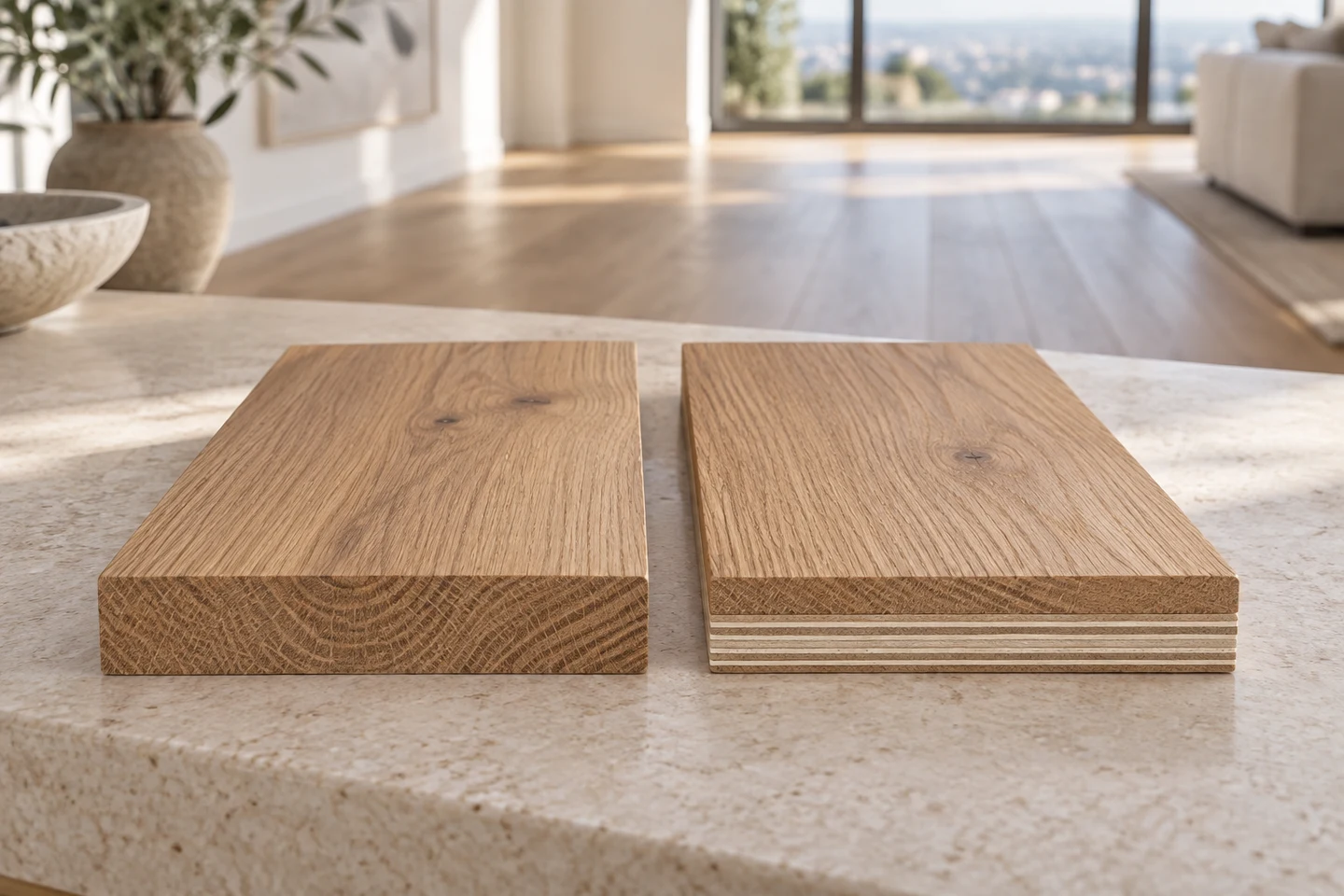
For most Los Angeles homes, the choice between engineered vs solid hardwood comes down to what's underneath. A concrete slab, a raised foundation over a crawlspace, radiant heating and local moisture conditions each favor one product or the other. Both are real wood on the surface. This guide explains how they differ, where each fits, and what drives the cost of the project.
How engineered and solid hardwood are built
Solid hardwood is milled from a single piece of wood, traditionally about three-quarters of an inch thick, and is typically nailed down to a wood subfloor. Because it's wood all the way through, it can be sanded and refinished several times over its life.
Engineered hardwood has a top layer of real wood, called the wear layer, bonded to a core of plywood or another engineered material, with layers running in different directions. That cross-layered build makes it more dimensionally stable, meaning it expands and contracts less as humidity changes. Depending on the product, it can be glued down, nailed or floated. From above, a quality engineered floor and a solid floor can look the same once installed.
Slab vs raised foundation: the deciding factor
Many LA homes, especially newer houses and many condos, sit on a concrete slab. Others, including many older homes, are built on a raised foundation with a crawlspace and a wood subfloor. This one detail often settles the question.
On a slab, engineered hardwood is usually the practical choice. Many engineered products are approved for glue-down or floating installation over concrete, while solid hardwood generally is not recommended for direct installation on a slab. Putting solid wood over concrete typically requires building a wood subfloor on top, which adds height, cost and planning at doorways.
On a raised foundation with a sound plywood or plank subfloor, both are options. Solid hardwood nailed to the subfloor is the traditional approach. Engineered works well too and can reduce floor height and seasonal movement. Either way, check the crawlspace: a vapor retarder on the soil and adequate ventilation help keep moisture from reaching the floor.
In condos and apartments, check your association's rules before choosing either product. Many buildings require an approved sound-reducing underlayment under hard flooring to limit noise for neighbors below, and some require plans or product data to be submitted first. That requirement can affect floor height, the installation method and which products qualify.
Moisture, climate and wide planks
Wood responds to humidity. Coastal neighborhoods can stay humid for long stretches, while dry, windy periods inland can pull moisture out of wood quickly, opening small gaps between boards. Engineered flooring handles these swings better, which is one reason it's the common choice for wide planks, since wider solid boards are more prone to cupping and gapping.
Moisture testing is not optional. Concrete slabs are tested with methods such as in-situ relative humidity probes or calcium chloride tests, and the results are compared with the flooring and adhesive manufacturers' limits. Wood subfloors are checked with a moisture meter and compared with the flooring's moisture content. Flooring should be acclimated as the manufacturer directs, with the home at normal living conditions.
- Is the home on a slab or a raised foundation?
- Has the slab or subfloor been moisture tested?
- Is there a vapor retarder in the crawlspace?
- Is there radiant heat, or plans to add it?
- Does the home face big seasonal humidity swings?
- How wide are the planks you want?
Engineered vs solid hardwood over radiant heat
If your home has in-floor radiant heating, engineered hardwood is generally the better match because its layered core tolerates temperature changes with less movement. Always choose a product the manufacturer specifically approves for radiant heat, and follow its limits on surface temperature and warm-up procedures. Solid hardwood over radiant heat is possible in some cases but is more restrictive, often favoring narrower boards and particular species.
Refinishing, lifespan and floor height
Solid hardwood's biggest advantage is how many times it can be sanded and refinished. That makes it appealing if you expect to live in the home for decades or want the option to change the stain color later.
With engineered flooring, refinishing depends on the wear layer. Thicker wear layers can typically be sanded at least once, sometimes more. Thin wear layers may allow only a light screen-and-recoat, not a full sanding. If refinishing matters to you, ask for the wear layer thickness before comparing products.
Height is the other practical difference. A thinner engineered floor can make transitions to tile easier and reduce the need to trim doors or adjust appliance clearances.
What drives the cost
We don't publish prices because the biggest factors depend on your home. For both types, cost is driven by species and grade, plank width and length, wear layer thickness for engineered products, and prefinished versus site-finished boards. On the installation side, it depends on removing the old floor, subfloor leveling or moisture mitigation, the installation method, patterns such as herringbone, stairs, transitions and baseboard work. Occupied homes with furniture to move add time as well.
To quote it, send photos of each room, approximate square footage, your foundation type if you know it, the current flooring and your preferred samples. We'll confirm testing and preparation during the site review.
In short: on a slab, with radiant heat, in a condo with height limits, or for wide planks, engineered is usually the practical choice. On a raised foundation where you want the longest possible refinishing life, solid hardwood remains a strong option. The right answer comes from your subfloor, not from the product label.