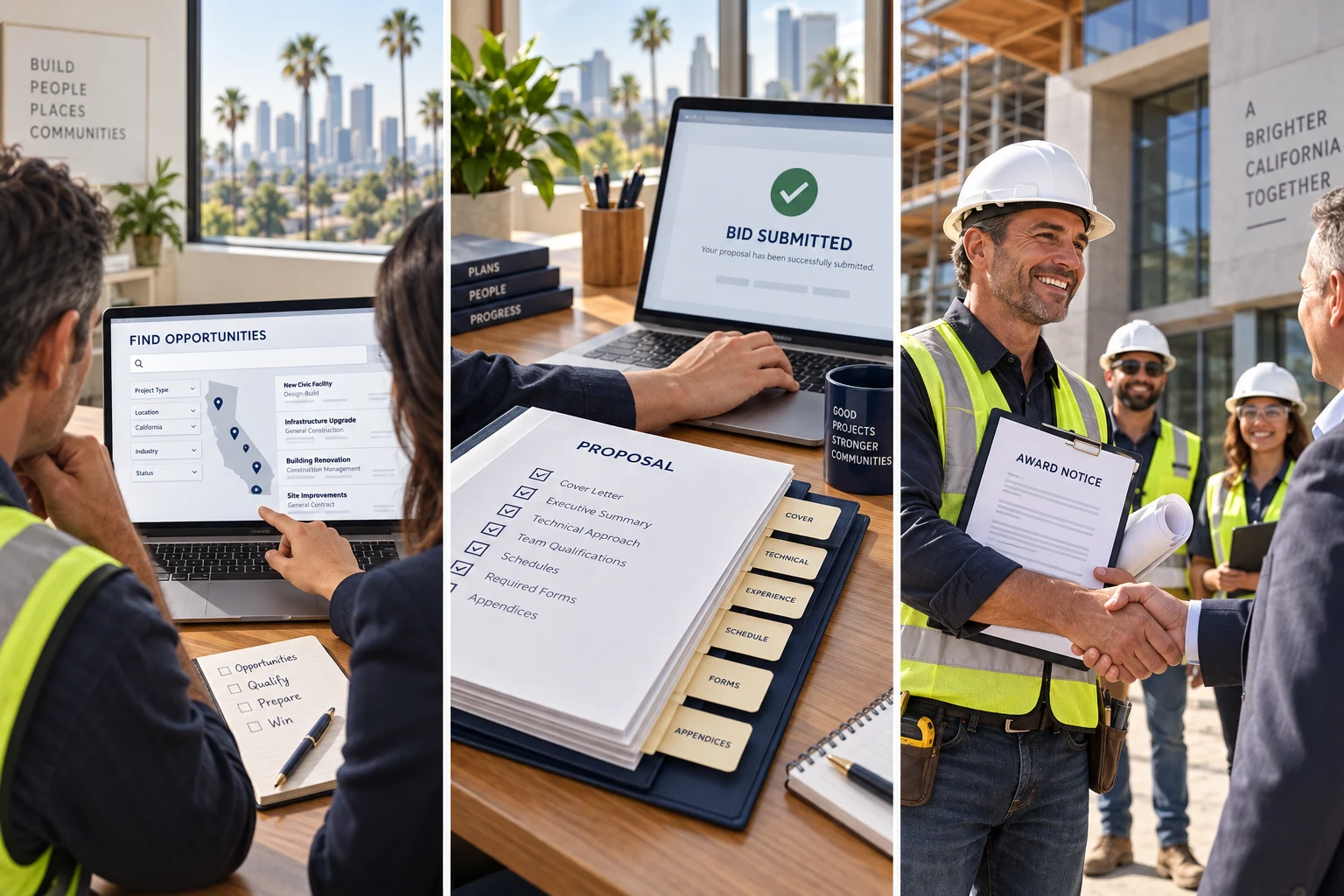
California construction bids are spread across a state portal, hundreds of city, county and district systems, and private invitations from owners and general contractors. A licensed contractor who searches everything usually ends up bidding nothing well. This guide shows where opportunities are posted, what registrations you need before a public bid counts, and how to filter the list down to projects worth pricing.
Start with a bid profile, not a search bar
Before opening a single portal, write down what a good opportunity looks like for your company. Search filters work only when you know what to filter for, and a clear profile makes go or no-go decisions faster later.
- Active CSLB license number and classifications
- Trades and work types you can self-perform, and those you subcontract
- Contract size range you can take on, and your bonding capacity
- Geographic area your crews can realistically cover
- Current backlog and when you could start new work
- Relevant project experience and references
- Certifications held, such as SB or DVBE
- Public works registration status with DIR
Keep this profile current. Bonding capacity and backlog change through the year, and an opportunity that was out of reach in spring may fit in the fall.
Build a standing document library alongside the profile: license and registration details, insurance certificates, bonding company contact, safety program summary, a list of completed projects with owner contacts, key staff resumes and standard company information. Many solicitations ask for the same items in different formats. Having current versions in one place turns a scramble into an afternoon of formatting, and it makes quick screening decisions far easier.
Where public bids are posted: Cal eProcure and local portals
Cal eProcure is the State of California's procurement portal, run by the Department of General Services. Many state agencies post solicitations there, and you can search by keyword, agency, date and category. Registering as a supplier lets you list the goods and services you provide, which some agencies use to find and notify bidders.
Not every state entity uses Cal eProcure for every construction project. Some departments, universities and special agencies run their own bid systems or post through other channels, so check the procurement page of any agency you target regularly.
Most public construction in California is let by local agencies: cities, counties, school and community college districts, water and sanitation districts, transit agencies and ports. Many use hosted e-bidding platforms such as PlanetBids, where each agency has its own vendor registration. The City of Los Angeles posts opportunities through its Business Assistance Virtual Network, known as LABAVN, and many other agencies maintain their own purchasing pages.
Because registrations are per agency, pick the agencies whose work matches your profile and register with each one, selecting the work categories that fit your trades. Set up email notifications, and download documents only from the official posting, so you are recorded as a plan holder and receive addenda.
Once notifications start arriving, keep one bid calendar for the whole company. Record each opportunity with its agency, bid date, pre-bid meeting, question deadline and prequalification deadline, plus a status such as watching, pricing, declined or submitted. A shared calendar prevents the classic miss where a mandatory site walk is noticed the day after it happened.
Do not overlook work as a subcontractor. On many public projects, prime contractors must list subcontractors above a threshold set by law in their bids, and they look for reliable, registered trade partners before bid day. Watching planholder lists on agency portals shows which primes are pursuing a project, and reaching out early with a clear scope and price can put your firm on their list.
DIR registration and public works rules
Contractors and subcontractors who bid on or perform California public works projects generally must be registered with the Department of Industrial Relations under its public works contractor registration program. Registration is required at the time of bid for most projects, applies to subcontractors listed in a bid, and must be renewed. Limited exemptions exist for certain small projects; check current DIR guidance for the thresholds.
Public works also carry prevailing wage requirements, certified payroll reporting and, in many cases, apprenticeship obligations. Read each solicitation's labor compliance section before pricing, because these rules affect both your labor cost and your administrative workload.
Prequalification and SB/DVBE certification
Some public agencies, including many school districts on larger projects, require bidders to prequalify before they can submit a bid. Prequalification usually involves a questionnaire covering financial information, experience, safety record, licensing and legal history, and it often has its own deadline ahead of the bid date. Missing that deadline can take you out of an opportunity entirely.
The DGS Office of Small Business and Disabled Veteran Business Enterprise Services certifies eligible firms as Small Business (SB) or Disabled Veteran Business Enterprise (DVBE). State agencies have participation goals for these groups, and some solicitations include DVBE participation requirements or bid incentives. Certification is not required to bid, but it can help on state work and makes you a useful partner for primes pursuing participation goals.
Private tenders and invitations to bid
Private work, from commercial buildings to multifamily and institutional projects, is rarely posted publicly. Owners and general contractors send invitations to bid to trade partners they know, often through bid management platforms and plan rooms. Getting on those lists means building relationships: prequalifying with general contractors, responding reliably, and submitting clear scope letters even when you decline.
Private bids have different rules from public ones. There is usually no mandatory DIR registration unless the project is publicly funded, terms are negotiated rather than fixed by statute, and bid-day expectations vary by general contractor. Read each invitation carefully and ask how the GC wants scope and exclusions presented.
Treat every private invitation as a relationship, even when you pass. A short, prompt reply that says you are declining, and why, keeps you on the list. When you do bid, a clear scope letter with inclusions, exclusions and assumptions makes your number easy to compare, and general contractors remember trade partners whose numbers hold up after award.
Screening California construction bids before you price them
A good search produces more opportunities than you can bid. Screen each one quickly before committing estimating time. If an opportunity fails a hard requirement, drop it and move on.
Estimating time is your scarcest resource. A realistic target is to bid fewer projects and prepare each one thoroughly, with complete subcontractor coverage and a careful document review, rather than sending thin bids to every posting. Track outcomes too: which agencies, sizes and project types you win or come close on tell you where to focus the next search.
- Your license classification matches the required classification
- The project size fits your bonding capacity and cash flow
- You can meet experience, prequalification and certification requirements
- The location and schedule work with your backlog
- Mandatory pre-bid meetings or site walks fit your calendar
- There is enough time to get subcontractor and supplier pricing
- Insurance, bonding and labor compliance requirements are achievable
- You understand the owner, the scope and the likely competition
How our tender consulting helps
Chain Construction offers online tender consulting for contractors already licensed in California. We help define your bid profile, set up searches, shortlist and screen opportunities, and organize documents for the ones you choose to pursue. We do not provide license application services, and we do not guarantee awards; the bid decision, pricing and submission remain yours.
To start, send your CSLB license number and classifications, trades, target contract sizes, preferred regions, current capacity, and any existing registrations or certifications. We will review them with you and suggest where to focus first.