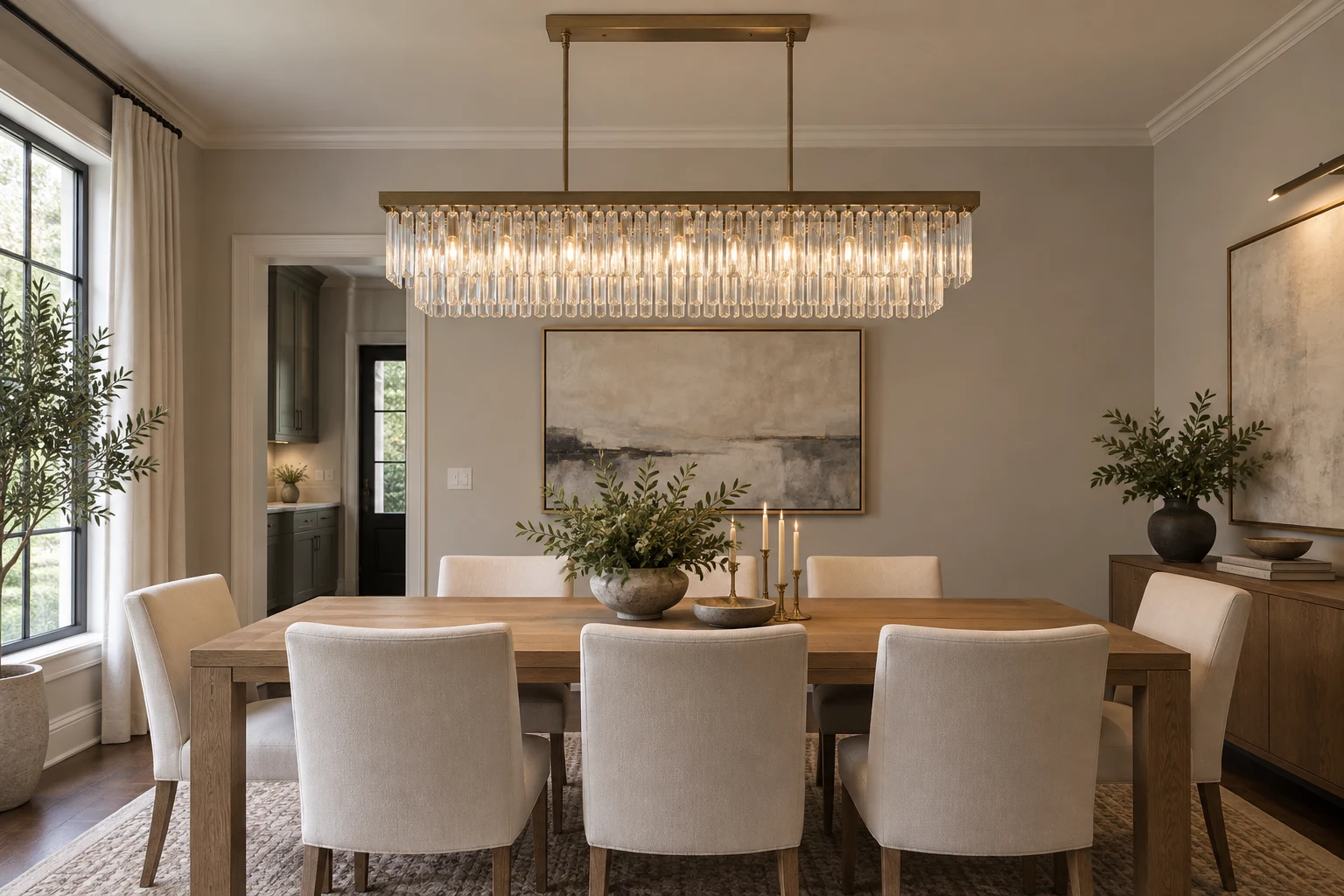
A large chandelier installation is mostly about three things: a ceiling support that can carry the fixture's weight, a hanging height that suits the room, and safe access to work at height. Whether the fixture goes in a two-story entry or over a long dining table, sorting those out before the fixture arrives saves a second visit and protects the ceiling.
Large chandelier installation starts with weight and the spec sheet
Every chandelier comes with a specification sheet that lists its weight, overall height, canopy size, chain or rod length, and the type of bulb or LED module it uses. That sheet drives almost every decision that follows, so send it along with the product listing before anything is ordered or scheduled.
Weight matters most. The electrical code allows a standard ceiling outlet box to carry a light fixture only up to a limited weight, commonly cited as 50 pounds, unless the box is listed and marked for a heavier load. Above that, the fixture has to be supported independently of the box or hung from a box rated for the actual weight. Large crystal and wrought-iron pieces often cross that line, and assembled weight can be higher than you expect once glass or crystal is added.
Ceiling support: rated boxes, bracing and framing
A box that is rated for a ceiling fan is not automatically rated for a heavy chandelier, and a fan brace sitting between joists is not the same as a solid mounting point. The electrician looks at what is above the ceiling and chooses a support that matches the fixture: a box listed for the weight, a brace fastened to framing, added blocking, or a separate structural hanger that carries the load while the box only carries the wiring.
In many Los Angeles homes, the space above a dining room or foyer is reachable from an attic, which makes adding blocking fairly straightforward. Under a second floor or a finished ceiling with no attic above, reinforcement may mean opening and patching drywall or plaster, so ask how the ceiling will be repaired and who handles the paint touch-up.
Dining room chandelier height and sizing
Over a dining table, lighting guides commonly suggest leaving about 30–36 inches between the tabletop and the bottom of the fixture in a room with an 8-foot ceiling, and raising it a few inches for each additional foot of ceiling height. Treat that as a starting point, not a rule. Sit at the table and check that the fixture doesn't block sightlines across the table.
For a long or linear fixture, center it on the table rather than on the room, and keep it shorter than the table so people at the ends don't bump into it. If the ceiling box isn't centered over where the table will sit, the box may need to be moved, which is ordinary electrical work but should be in the quote.
In a foyer or stairwell with a tall ceiling, the fixture is usually hung so its bottom clears the walking path comfortably and it reads well from the second-floor landing and the front door. Decide this before assembly, because chains and rods are cut or linked to length during the job.
Working at height: ladders, lifts and scaffolding
A dining room with a 9- or 10-foot ceiling can usually be handled from ladders. A double-height entry or a ceiling over a staircase often needs a rolling scaffold or a compact lift, plus a second person to hold and guide the fixture while it is connected. Access equipment adds cost and setup time, so the installer needs photos showing the ceiling height, stairs, railings and the floor finish.
- Measure the floor-to-ceiling height at the mounting point, including over stairs
- Photograph the path from the front door to the room for carrying a large box and scaffold
- Note delicate flooring, rugs or furniture that need protection or moving
- Mention any fire sprinkler heads, beams or skylights near the fixture location
- Tell us if the fixture should be on a hoist or lowering system for cleaning
Plan for assembly time too. Large crystal chandeliers often arrive with hundreds of separately packed pieces that are hung by hand after the frame is mounted. Ask whether crystal hanging is included in the installation price or quoted separately, and leave a clear table or floor area where parts can be laid out.
Dimmers, controls and bulb compatibility
A chandelier on a dimmer is almost always nicer, but not every dimmer works with every LED fixture or bulb. Mismatches cause flicker, buzzing or a light that won't dim smoothly at the low end. Check the fixture's spec sheet for compatible dimmer types before buying, and plan to replace the wall switch at the same visit if needed.
Consider how the fixture will be controlled from more than one entrance, whether you want separate control for accent or recessed lights in the same room, and whether a smart switch is in the plan. Title 24 energy rules in California also affect lighting controls in some remodel situations, which the electrician will flag if they apply.
What we need from you to quote it
A clear quote for a heavy or high fixture depends on seeing the ceiling and the fixture before the visit. Send the following to Chain Construction and we'll review it with our licensed electrical contractor.
- Fixture product page and specification sheet with weight and dimensions
- Photos of the existing ceiling box and fixture, and the room from the doorway
- Ceiling height and whether there is attic access above
- Table size and location for a dining room fixture
- Preferred dimmer or switch type and how many switch locations
- Your address and a few possible dates for the installation
If the job includes new circuits, relocated boxes or ceiling reinforcement, the electrician will explain whether a permit applies in your city. Moving a box and adding framing is common; it simply needs to be scoped up front.